


Can we PLEASE stop making people think they need 20% down to buy a house?
Because somewhere out there, someone is putting off buying their first home in Tacoma, Gig Harbor, or the South Sound because they think they need $100,000 sitting in their savings account before they can even start looking.
And I'm here to tell you: that's not necessarily true.
The idea that you need 20% down to buy a house is one of the biggest misconceptions in real estate.
Now, does that mean you can buy a house with absolutely no savings and no financial plan? No.
But it does mean you might have more options than you realize.
Let's talk about it.
So, How Much Do You Actually Need for a Down Payment?
The answer depends on your loan program, financial situation, and what you qualify for.
And here's where things get interesting.
Conventional Loans — As Little as 3% Down
Yes, 3%.
Certain conventional loan programs allow eligible buyers to purchase a primary residence with as little as 3% down. Of course, elegibility requirements apply.
That means on a $500,000 home, a 3% down payment would be $15,000.
Not $100,000.
Of course, eligibility requirements apply, and putting less down can affect your monthly payment and mortgage insurance costs.
FHA Loans — As Little as 3.5% Down
FHA loans are another option worth exploring, particularly for buyers who may benefit from more flexible credit requirements.
With an eligible FHA loan, the minimum down payment can be as low as 3.5%.
On a $500,000 home, that's $17,500.
FHA loans also have mortgage insurance requirements and loan limits, so they're not automatically the best choice for everyone.
VA Loans — Potentially 0% Down
For eligible veterans, active-duty service members, and certain surviving spouses, VA loans can offer an incredible benefit: the ability to purchase a home without a required down payment.
That doesn't necessarily mean zero out-of-pocket expenses. Closing costs and other expenses may still apply, and some borrowers pay a VA funding fee.
But it's an option that can make homeownership more accessible for eligible buyers.
USDA Loans — Potentially 0% Down
USDA loans may also offer no-down-payment financing for eligible buyers purchasing qualifying homes in designated rural areas.
And no, that doesn't necessarily mean you have to buy a farm.
Property location, household income, and other eligibility requirements apply.
The important takeaway?
Twenty percent is not the universal minimum down payment for buying a house.
What Does That Actually Look Like on a $500,000 Home?
Let's put some numbers to it.
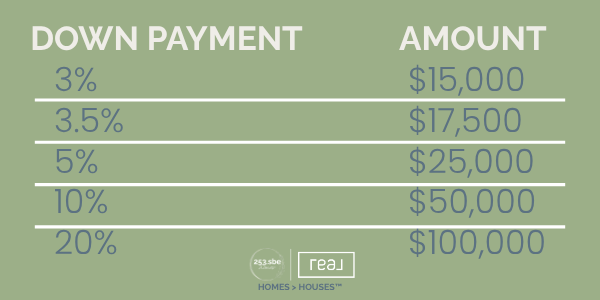
That's a pretty significant difference.
Now, these are down-payment examples only. They don't include closing costs, prepaid expenses, mortgage insurance, or other costs associated with purchasing a home.
And a smaller down payment generally means you're borrowing more money, which can increase your monthly payment.
So we're not just looking at how little you can put down.
We're looking at what actually makes sense for you.
Your Down Payment Isn't Your Only Expense
This is something I really want buyers to understand.
Your down payment and your closing costs are two different things.
In addition to your down payment, you may need funds for expenses such as your appraisal, lender and title fees, prepaid homeowners insurance, property taxes, and other transaction costs.
Depending on your financing and the terms of your purchase, some of those costs may be covered through negotiated seller concessions or other permitted assistance.
But the amount you'll actually need to bring to closing depends on your specific transaction.
And let's not forget about life after closing.
Because buying a home is exciting, but so is being able to afford groceries, furniture, unexpected repairs, and the occasional weekend away.
I don't want you stretching yourself so thin to buy a house that you can't actually enjoy living in it.
What About Mortgage Insurance?
Here's where that 20% number comes into play.
With many conventional loans, putting less than 20% down means you'll typically have private mortgage insurance, also known as PMI.
PMI protects the lender if the borrower defaults on the loan, and it adds to the cost of financing.
The good news? Depending on your loan and applicable requirements, PMI may eventually be canceled as you build equity.
FHA loans have different mortgage insurance rules, and their insurance isn't the same as conventional PMI.
This is exactly why I recommend working with a knowledgeable lender who can compare different loan options and explain the long-term costs.
Sometimes a smaller down payment makes sense.
Sometimes putting more down is the better financial decision.
The goal isn't just getting you into a house. It's making sure the numbers work for your life.
Washington State Has Down Payment Assistance Programs, Too
Here's something else that doesn't get talked about nearly enough.
Washington State has programs designed to help eligible buyers with down payments and closing costs.
The Washington State Housing Finance Commission offers homeownership programs, including down payment assistance options available through participating lenders.
Depending on the program, assistance may come in the form of a second mortgage with its own repayment terms, rather than free money.
Eligibility, income limits, education requirements, financing options, and available assistance vary by program.
That's why it's worth speaking with a participating lender to find out what you may qualify for.
You can also explore programs through the Washington State Housing Finance Commission at www.wshfc.org.
Should You Put Less Than 20% Down?
Maybe!
But just because you can doesn't automatically mean you should.
There are some really important things to consider.
What will your monthly payment look like?
How much money will you have left after closing?
Will you have a comfortable emergency fund?
How do the different loan programs compare?
And does buying a home actually fit your financial goals right now?
Those are the conversations worth having.
Because there isn't one magic down-payment percentage that works for everyone.
Don't Count Yourself Out Before You Know Your Options
If buying a home in Tacoma, Gig Harbor, or anywhere around the South Sound has been on your mind, but you've been holding off because you don't have 20% saved up, I'd encourage you to explore your options before deciding it's out of reach.
You don't need to know exactly what you qualify for before reaching out to me.
You don't need to have your entire homebuying timeline figured out.
And you definitely don't need to apologize for asking questions when you're still months or even a year away from buying.
We can talk about what you're hoping to accomplish, connect you with a trusted lender who can walk you through the financing side, and figure out what your next steps might look like.
Maybe you're closer than you thought.
Maybe you've got some saving or planning to do first.
Either way, you'll have a better understanding of what's possible.
Because sometimes a conversation is just the place to start.
Sarah Brandt-Erichsen | 253sbe Homes
Real estate that feels like you.
Financing information is provided for general educational purposes. Loan programs, qualification requirements, down-payment assistance, and mortgage insurance terms vary. A licensed mortgage lender can help determine your eligibility and provide estimates specific to your situation.